
Jurisdiction under the EU Succession Regulation: In cross-border inheritance matters, international jurisdiction within the European Union is primarily governed by the EU Succession Regulation. In practice, one of the key questions is which court has jurisdiction when an estate has connections to several countries. This issue becomes particularly complex where the deceased had their last habitual residence outside the European Union, but estate assets are located in an EU Member State.
This is precisely the issue addressed by the Austrian Supreme Court in its decision of 20 January 2026, 2 Ob 165/25s. The Supreme Court has referred a question to the Court of Justice of the European Union on whether the subsidiary jurisdiction under Article 10(2) of the EU Succession Regulation also covers an action seeking payment of a monetary forced heirship claim.
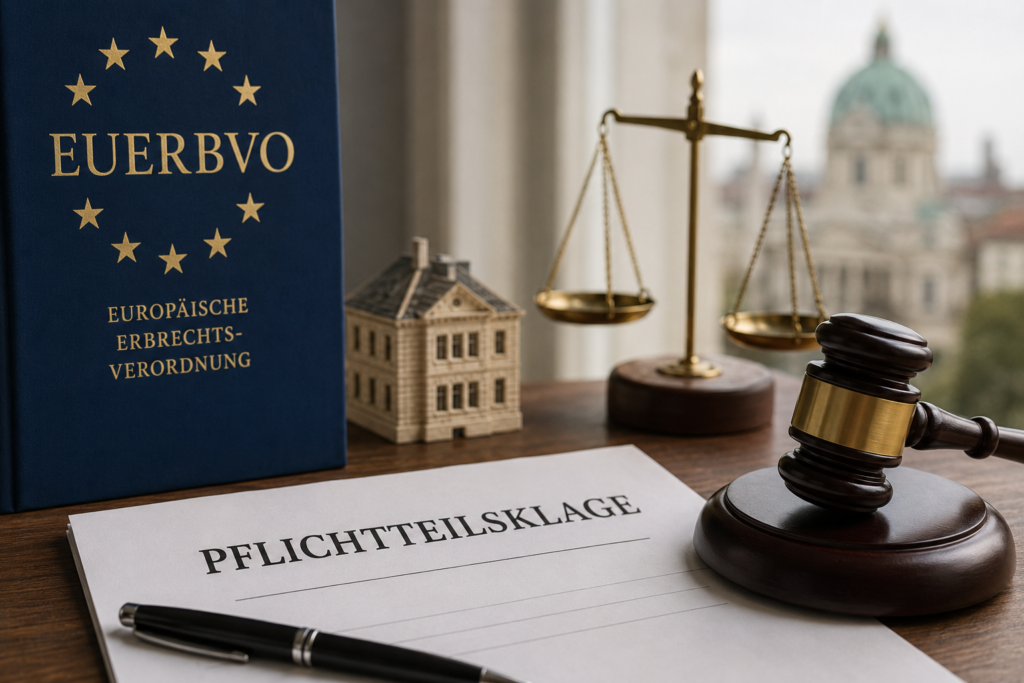
The deceased passed away in 2021. His last habitual residence was in the Republic of Moldova. The estate, however, included an apartment in Vienna. There were no indications that the deceased had previously had his habitual residence in Austria or that further estate assets were located in another EU Member State.
The Austrian probate court dealt with the Austrian part of the estate on the basis of Article 10(2) of the EU Succession Regulation and transferred the Austrian estate assets to the testamentary heir. The heir later sold the apartment to a third party. Another daughter of the deceased subsequently asserted a forced heirship claim and sought payment of EUR 25,555.
The claimant also relied on Article 10(2) of the EU Succession Regulation to establish the international jurisdiction of the Austrian courts. The lower courts rejected the claim for lack of international jurisdiction. The Austrian Supreme Court considered the interpretation of this jurisdictional rule to be unclear and therefore referred the matter to the Court of Justice of the European Union for a preliminary ruling.
Article 10 of the EU Succession Regulation provides for subsidiary jurisdiction in cases where the deceased did not have their habitual residence in a Member State at the time of death. Under Article 10(1), the courts of a Member State may, under certain additional conditions, have jurisdiction to rule on the succession as a whole. This may be the case, for example, where estate assets are located in that Member State and the deceased either had the nationality of that Member State or had previously had their habitual residence there.
Where Article 10(1) does not apply, Article 10(2) may become relevant. Under this provision, the courts of the Member State in which estate assets are located have jurisdiction to rule on those estate assets.
This wording is the core of the legal issue. Does jurisdiction to rule “on those estate assets” only cover proceedings that directly concern rights in the assets located in that Member State? Or is it sufficient that the claim is economically derived from those assets?
A narrow interpretation is supported by the wording of Article 10(2) of the EU Succession Regulation. Unlike Article 10(1), Article 10(2) does not establish jurisdiction over the succession as a whole. Instead, jurisdiction is limited to decisions concerning the estate assets located in the relevant Member State.
In a monetary forced heirship claim, however, the claimant does not seek transfer of the apartment or the creation of a right in rem over that property. The claimant seeks payment of a sum of money. The apartment merely serves as a basis for calculating the compulsory portion.
According to this narrow interpretation, Article 10(2) would apply only to proceedings that directly concern the estate assets located in Austria. This could include issues relating to the transfer of the Austrian estate, the allocation of the asset, or rights directly affecting the property. A purely monetary claim for payment of a compulsory portion would not fall within the subsidiary jurisdiction under Article 10(2).
There are, however, strong arguments in favour of a broader interpretation. Forced heirship claims generally fall within the substantive scope of the EU Succession Regulation. The Regulation covers civil-law aspects of succession to the estate of a deceased person. It also expressly refers to the compulsory portion and other restrictions on the freedom of disposition upon death.
If forced heirship claims fall within the EU Succession Regulation, it appears consistent to apply the Regulation’s jurisdictional rules to such claims as well. Otherwise, an artificial division could arise: the Austrian court would have jurisdiction over the Austrian estate asset in the probate proceedings, but not over a subsequent forced heirship claim derived from that same estate asset.
This is particularly relevant where the estate asset has been sold after the death of the deceased. If the later sale of the apartment were to remove or prevent jurisdiction, subsequent actions by the heir could affect the international jurisdiction of the courts. That would undermine predictability and legal certainty in cross-border succession cases.
The CJEU’s ruling will be highly relevant for cross-border inheritance cases. Many deceased persons have their last habitual residence outside the European Union while still owning assets in Austria, Germany, or another EU Member State. Real estate in particular often leads to probate or succession proceedings in the country where the property is located.
The decision will clarify whether jurisdiction under the EU Succession Regulation pursuant to Article 10(2) also extends to monetary forced heirship claims where the claim is derived from estate assets located in a Member State. For forced heirs, this is a crucial point. They need to know whether they can bring their claim before the courts of the Member State where the estate asset is located or whether they must rely on another jurisdiction.
The issue is equally important for heirs. If Article 10(2) is interpreted broadly, heirs may face not only probate proceedings in the Member State where estate assets are located, but also subsequent forced heirship litigation in that jurisdiction.
The Austrian Supreme Court considers both interpretations to be arguable. On the one hand, the wording of Article 10(2) of the EU Succession Regulation supports a limitation to proceedings directly concerning the estate assets located in the Member State. On the other hand, the structure and purpose of the Regulation suggest that monetary forced heirship claims may also be covered where they are derived from those estate assets.
Until the CJEU has ruled on the matter, the legal position remains uncertain. In cross-border inheritance cases involving estate assets in Austria, international jurisdiction should therefore be assessed with particular care. This applies especially to forced heirship claims where the deceased had their last habitual residence outside the European Union.
Our law firm advises and represents clients in cross-border inheritance matters, particularly in cases involving Austria and Hungary. We assist heirs and forced heirs with questions of international jurisdiction, the enforcement of compulsory portion claims, and representation in Austrian probate and court proceedings.