
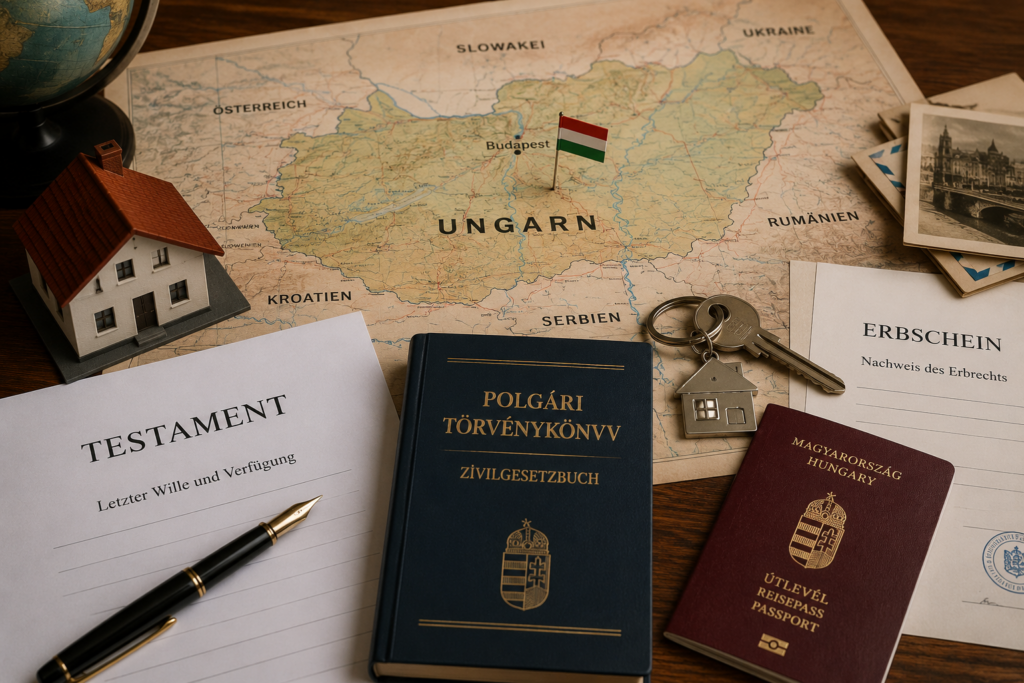
A will in Hungary is an important legal tool for anyone who owns assets, real estate, bank accounts, company shares or family property in Hungary. A properly drafted will can help avoid disputes between heirs, clarify who should inherit specific assets and make the Hungarian probate process smoother for the family.
Under succession law, a person making a will in Hungary — commonly referred to as the testator — may generally decide who should inherit their estate after death. However, this freedom is not unlimited. Hungarian law contains strict formal requirements for wills and also recognises certain mandatory inheritance rights, often referred to as forced heirship or reserved share rights.
For international families, foreign property owners and heirs living outside Hungary, professional legal advice is especially important. A will that appears valid in one country may still raise practical or legal questions in Hungary.
A will is particularly useful if the default rules of intestate succession do not reflect your wishes. If someone dies without a valid will, Hungarian intestacy rules determine who inherits the estate. These rules usually prioritise close family members, such as descendants and the surviving spouse.
A will in Hungary may be useful where:
For foreign nationals, a will can also be part of wider cross-border estate planning. This is particularly relevant for British, American, Australian, Canadian, German or Austrian clients with property or family interests in Hungary.
Hungarian law recognises several types of wills. The most important categories are authentic wills, written private wills and, in exceptional cases, oral wills.

An authentic will is made before a Hungarian notary public. This form is often the safest option from a formal point of view, because the notary ensures that the document complies with the applicable legal requirements.
An authentic will may be particularly advisable if the estate includes valuable real estate, business assets, family property or if a dispute between potential heirs is foreseeable.
A holographic will is a handwritten will. Under Hungarian law, this type of will must be entirely written and signed by the testator personally. It is not sufficient to type the document on a computer and then sign it.
A holographic will can be a simple and cost-effective option, but it is also vulnerable to mistakes. Problems may arise if the text is unclear, if the date is missing or if the will does not clearly express a final testamentary intention.
An allographic will is a written private will that is not entirely handwritten by the testator. This includes wills typed on a computer or drafted by another person. In Hungary, typewritten wills are treated as allographic wills, even if the testator typed the document personally.
An allographic will must comply with additional formal requirements. In particular, two witnesses must usually be involved, and they must sign the document in their capacity as witnesses. If the will consists of several pages, further requirements apply, including page numbering and signatures on the relevant pages.
A private will can also be deposited with a Hungarian notary. This may improve legal certainty and helps ensure that the will can be found during the Hungarian probate proceedings.
This is an important practical point. A will is only useful if it is located and presented in the probate process after death.
Oral wills are only valid in exceptional circumstances. They are generally limited to extraordinary life-threatening situations where making a written will is not possible. Because of their exceptional nature, oral wills should not be used for ordinary estate planning.
Many inheritance disputes in Hungary arise not because of the substance of the will, but because of formal defects. A will may be challenged if it does not comply with Hungarian formal requirements.
Important points include:
Even small formal mistakes can lead to serious consequences. For this reason, a will concerning assets in Hungary should be reviewed by a lawyer familiar with Hungarian inheritance law.
After death, the estate is generally dealt with in Hungarian probate proceedings. These proceedings are usually handled by a Hungarian notary rather than a court in ordinary cases.
During the probate process, the notary identifies the estate, reviews the available documents, examines the will if one exists and determines who is entitled to inherit. For foreign heirs, the process can involve translations, foreign documents, powers of attorney and communication with Hungarian authorities.
Typical documents in an inheritance case may include:
For heirs living abroad, legal representation in Hungary can simplify the process significantly.
International estates require special attention. If the deceased lived in one country but owned assets in Hungary, the applicable inheritance law must be determined.
For many EU-related cases, the EU Succession Regulation is highly relevant. In general, succession is often governed by the law of the country where the deceased had their habitual residence at the time of death. However, a person may choose the law of their nationality to govern their succession.
This choice of law should be made clearly, usually in a will or separate declaration. It may be particularly important for foreign nationals who own property in Hungary but want their national inheritance law to apply.
However, not every country participates in the EU Succession Regulation. For example, Ireland and Denmark do not participate. The United Kingdom is also outside the EU framework. Therefore, estates involving the UK, the United States, Australia or other non-EU jurisdictions require separate private international law analysis.
A will in Hungary does not always mean that close family members can be completely excluded. Hungarian law recognises mandatory inheritance rights, commonly described in English as forced heirship or reserved share rights.
Certain close relatives may be entitled to a compulsory portion of the estate even if the will provides otherwise. This can be especially relevant where a testator leaves everything to one person, excludes a child, or favours a spouse, partner or third party.
For this reason, any Hungarian estate plan should consider potential forced heirship claims in advance.
A will can generally be changed or revoked during the testator’s lifetime. However, problems may arise if several wills exist and it is unclear whether an earlier will was fully revoked or only partly amended.
A new will should therefore state clearly whether previous wills and testamentary dispositions are revoked. This helps avoid later disputes during probate.
RUZICSKA LEGAL advises private clients, heirs and families on wills, probate and inheritance matters involving Hungary.
Our services include:
We advise clients in English, German and Hungarian and regularly assist international families with estates involving Hungary.
A will in Hungary can provide clarity, protect family members and make the probate process easier. However, Hungarian succession law contains strict formal requirements, and international estates often involve additional legal complexity.
If you own property or other assets in Hungary, or if you are an heir involved in Hungarian probate proceedings, it is advisable to seek legal advice at an early stage.
RUZICSKA LEGAL supports clients with Hungarian wills, probate, estate administration and cross-border inheritance matters.